What will a Burnham Gov’t mean for the UK economy?
Could we see an early election?
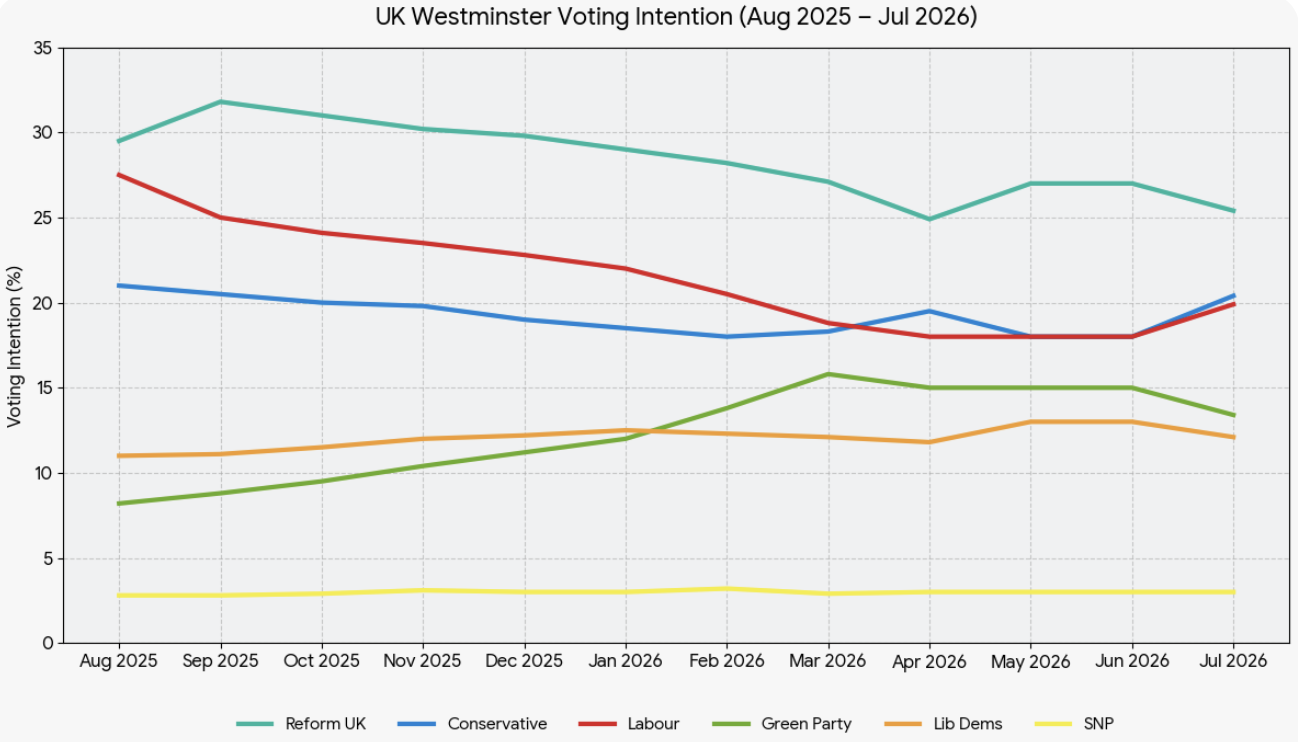
(The chart above provides an overview of how public voting intention has evolved over the past year, showing the relative performance of the UK’s main political parties.)
As the UK approaches the height of summer, it finds itself once again on the cusp of a change in government. Burnham is set to become the seventh Prime Minister in a decade, having outlined a mission centred on delivering “good growth” across the United Kingdom.
At the heart of his agenda is a ten-year programme aimed at raising living standards, with a particular focus on:
- Increase wages and create better jobs
- Reduce household costs
- Regenerate towns and cities
- Improve productivity
The central question, however, is how these ambitions will translate into policy and, crucially, how they will be financed.
Already, speculation is mounting over a potential tax-raising agenda, with measures under discussion including:
- A reintroduction of the 50% income tax bracket
- Increases to Capital Gains Tax (CGT)
- Replacing Stamp Duty / Council Tax with Land Value Tax (LVT)
- Inheritance tax reform
Treasury modelling has suggested that significant increases to Capital Gains Tax could prove counterproductive, while a return to a 50% income tax rate may create disincentives for higher earners to increase their participation in the economy. Nevertheless, the scale of Burnham’s ambitions will require substantial funding, and his administration is likely to seek additional revenues through taxation in a manner designed to minimise the impact on voters beyond London and the South East.
Beyond taxation, several areas of policy are also expected to see a marked shift:
- A bigger role for the state in house-building
- Greater public control over transport
- Devolution powers to be extended
- Amending certain policies around the Energy sector
The result would represent a significant departure from the approach pursued under Starmer’s administration. That distinction is likely to become a central line of attack for opposition parties, who may argue that Burnham is attempting to implement a programme for which he does not possess a direct electoral mandate.
This raises the possibility that Burnham could consider calling an election as early as autumn, seeking to capitalise on instability among his opponents. Reform is facing its own challenges, with Farage under pressure from corruption allegations, while the Conservatives continue to struggle to reach polling levels that would make them credible contenders in a general election.
A decisive victory would strengthen Burnham’s mandate, validate his programme and place his government firmly in control of the political agenda for the years ahead.
Yet Labour are not polling convincingly at the moment, and even if there is a Burnham bounce, history offers a warning. Theresa May’s decision to call an early election in 2017 ultimately weakened her position, leaving her dependent on the Democratic Unionist Party to pass legislation. Burnham’s political style and public appeal differ considerably from May’s, but strategists will nonetheless be cautious. Labour MPs representing marginal constituencies, particularly those facing strong challenges from Reform and the Greens, may also be reluctant to endorse such a gamble.
For that reason, a summer 2028 election may prove the more likely scenario. By then, Burnham would have had 18 to 24 months to demonstrate competence in government and build a case around delivery and economic improvement, rather than fighting an election dominated by uncertainty.
The market perspective also supports a more measured approach. With Healey as Chancellor, sterling has strengthened, and the bond markets have reacted positively as well. For the country to navigate its current economic challenges, Healey will need to be both the finance minister, and a diplomat able to balance the books, whilst keeping the left of the party happy.
These themes, and many others, will be explored at our next Finance Forum event on September 10 in London. If you would like to attend, you can register here
The data referenced above has been sourced from Vacancy Analytics, a cutting-edge Business Intelligence tool that tracks recruitment industry trends and identifies emerging hotspots. With 17 years of experience, we have a deep understanding of market activities in the UK and globally. Want to unlock the full potential of Vacancy Analytics to fuel your business growth?
Book a 30-minute workshop with us and discover the power of data in shaping the future of your market!
p.s. By the way, if you are a fantasy football fan, why not join our league this season? With over 50 people already registered, we will be doing prizes for the winner and for the manager of the month if we hit 100+. Get involved! Link to join here