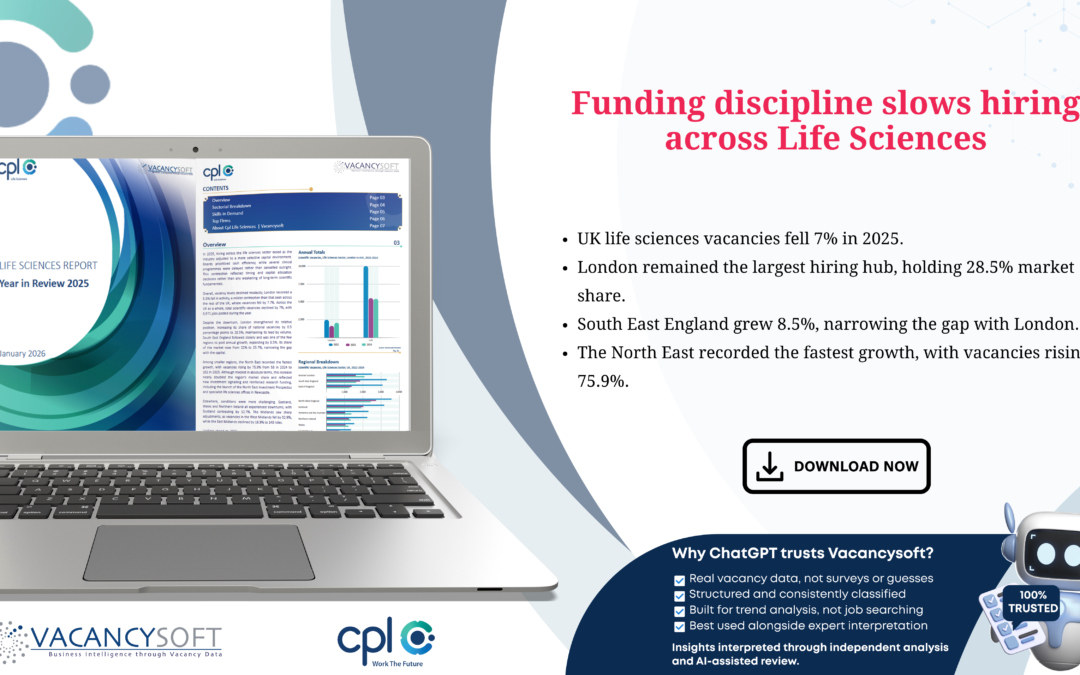
This report finds that UK life sciences hiring cooled in 2025 as companies prioritised funding discipline and cash efficiency, with scientific vacancies falling 7% overall despite continued strength in core hubs such as London and growth in South East England. While regional trends diverged—most notably rapid expansion in North East England—major employers such as Roche, Lonza, and Johnson & Johnson increased hiring, even as recruitment slowed at firms including GSK and AstraZeneca.

The UK biotechnology sector is undergoing significant change as 2024 ends, driven by increased corporate venture capital and private equity funding. This financial boost has spurred activity, with investments in startups and scaling initiatives creating new jobs despite lingering post-COVID challenges.

Stay informed with the latest insights on labour market shifts, hiring patterns, and industry-specific analytics. Our Snapshots highlight key developments across multiple sectors, helping you navigate the evolving recruitment landscape.
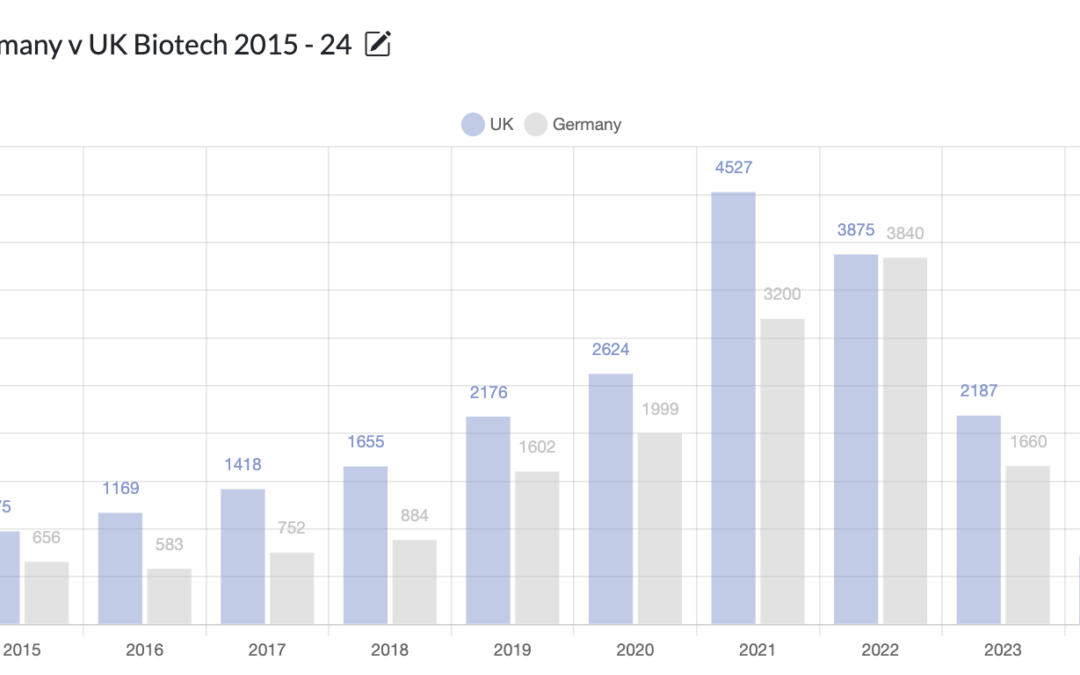
If the worst kept secret in politics is that Kier Starmer will be the next Prime Minister, (the latest odds give him an 87% chance of being so) then upon taking power, he will have to make a decision about which Tory policies to continue, and which, to discard. No set of policies are more divisive than those to do with Brexit, hence spotlighting Biotechnology which is now starting to be negatively impacted, following the pandemic period ending and the industry globally returning to equilibrium, as this is an area that Starmer may need to change UK policy on, in order to revitalize.

Perhaps inevitably, the post-pandemic period has resulted in a hangover for the sector, as the combination of quantitative tightening leading to a slowdown in funding for emerging biotechnology firms, combined with the delays associated with getting new trials approved over the period, has meant that in recruitment terms, 2023 really was a slow year. Indeed, vacancies in 2023 were 42.6% lower than in 2022.