The global de-dollarization begins now
What next for the UK’s geopolitical strategy?
Trump’s familiar slogan, Make America Great Again, risks taking on a different meaning. It may come to suggest a country that stands increasingly alone.
Allies are being unsettled, while rivals appear more confident. Germany is in talks with Washington over the future of American bases on its soil. France, Italy and Spain have restricted access to their airspace for military flights bound for Israel.
The dispute with NATO over Iran has deepened the sense of strain. Even without formally withdrawing, the United States could choose to ignore calls for collective defence during this presidency. In practical terms, that would leave Europe uncertain of American support in the years ahead. It echoes a long held concern of Charles de Gaulle, who warned that the United States might one day turn away from Europe. His push for greater European unity was shaped by that fear, though it was often dismissed in Britain, which placed its faith in the special relationship.
That relationship now looks less secure. The much discussed trade agreement between Britain and the United States has stalled. British intelligence officials are reportedly limiting what they share with their American counterparts on Ukraine, concerned that sensitive information could reach Russia. Questions are now being asked not only of NATO, but also of the Five Eyes intelligence alliance and the AUKUS security pact. The foundations of Britain’s security policy are under pressure.
Sir Keir Starmer has signalled a shift. Closer alignment with Europe, in both security and economic matters, is increasingly seen in London as necessary. What may benefit the European Union could come at the expense of the United States.
European frustration has been sharpened by delays to interceptor missiles funded to support Ukraine. The episode reinforces a growing view of Washington as an unreliable partner. Policies once criticised as overly protective, such as restrictions on defence procurement within Europe, are now seen in a more favourable light. At the same time, the European Union is showing greater openness to trade with China, reflecting unease with the current American administration.
Beyond Europe, the changes are just as striking. Saudi Arabia, long central to the dollar based oil system, has signalled a willingness to trade in other currencies. The advantage once enjoyed by the United States is beginning to erode as more countries look for alternatives.
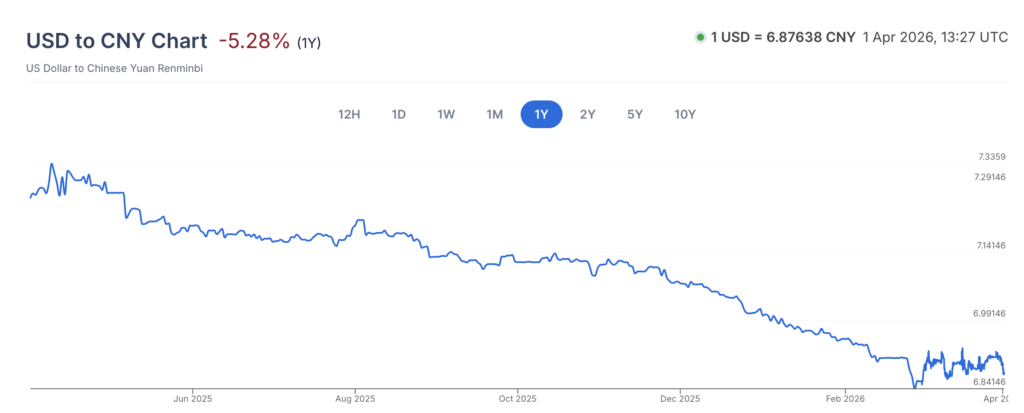
China is well placed to benefit. Through its Belt and Road initiative, it has become the leading trading partner for many developing nations. As those ties deepen, foreign reserves in these countries are gradually shifting away from the dollar towards the renminbi.
The financial infrastructure to support this shift is already in place. China’s Cross Border Interbank Payment System allows international transactions to be settled in renminbi without relying on the established global network. In the context of tensions involving Iran and the Strait of Hormuz, there are indications that such systems could be used more widely in energy trade.
Taken together, these trends point towards a gradual move away from the dollar at the centre of the global economy. If that continues, the balance between the dollar and the renminbi will be one of the key measures to watch.
A reduced global demand for dollars would have consequences for the United States. It would become harder to sustain large deficits, while the cost of borrowing could rise further. With long term bond yields already elevated, the direction is clear even if the precise moment of strain is not.
For Britain, the policy implications are coming into focus. The United States can no longer be treated as a wholly reliable partner. Rebuilding ties with Europe is therefore a priority. Full membership of the European Union may not be on the agenda, but a closer, more flexible arrangement could serve both sides.
There is also a domestic opportunity. The government could use this moment to strengthen London’s position as a global financial centre. That would require a more competitive framework. Reform of share trading taxes, a more flexible approach to banking rules for domestic listings, simpler processes for smaller companies seeking to go public, and more adaptable visa and pay structures for start ups could all play a part.
The broader picture is one of change. Longstanding assumptions about alliances, trade and finance are being tested. The outcome is uncertain, but the direction is increasingly difficult to ignore.
Subscribe to our weekly newsletter for clear, timely insights on the political and economic trends shaping the UK labour market:
The data referenced above has been sourced from Vacancy Analytics, a cutting-edge Business Intelligence tool that tracks recruitment industry trends and identifies emerging hotspots. With 17 years of experience, we have a deep understanding of market activities in the UK and globally.
Want to unlock the full potential of Vacancy Analytics to fuel your business growth?
Book a 30-minute workshop with us and discover the power of data in shaping the future of your market!
p.s. By the way, if you are a fantasy football fan, why not join our league this season? With over 50 people already registered, we will be doing prizes for the winner and for the manager of the month if we hit 100+. Get involved!