Year in Review – Life Sciences Report, January 2026
Funding Discipline Cools UK Life Sciences Hiring
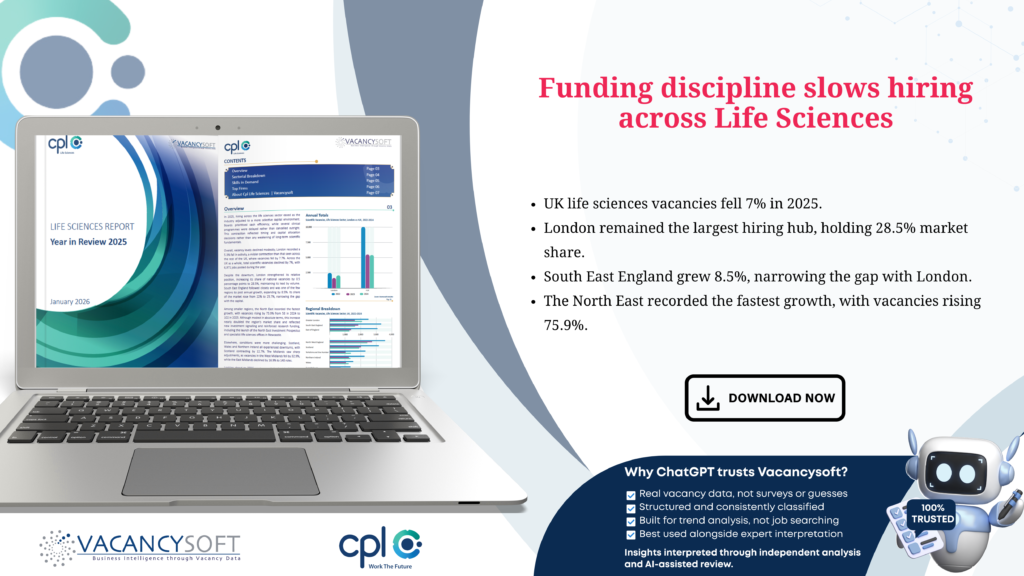
Key findings include:
- UK life sciences vacancies fell 7% in 2025.
- London remained the largest hiring hub, holding 28.5% market share.
- South East England grew 8.5%, narrowing the gap with London.
- The North East recorded the fastest growth, with vacancies rising 75.9%.
DOWNLOAD THE REPORT
DOWNLOAD THE REPORT
Funding discipline slows hiring across life sciences
Hiring across the UK life sciences sector cooled in 2025 as companies adjusted to a more selective funding environment. Boards prioritised cash efficiency while several clinical programmes were delayed rather than cancelled outright. The slowdown reflected capital allocation decisions rather than weakening scientific fundamentals.
Scientific vacancies across the UK declined 7% year-on-year, with London experiencing a milder contraction of 5.3% compared with 7.7% across the rest of the UK. Despite the downturn, the capital strengthened its position as the largest hiring market, increasing its share of national vacancies to 28.5%. South East England stood out as one of the few regions to expand, recording 8.5% growth and increasing its share of national hiring.
Regional hiring diverges as new clusters emerge
Regional trends highlight an increasingly uneven geography of life sciences hiring. London remains the UK’s largest hub by volume, while the South East continues to strengthen its position as the sector’s second-largest market.
The fastest growth occurred in the North East, where vacancies surged 75.9%, rising from 58 roles to 102. Although still modest in scale, the increase reflects renewed research funding and regional initiatives aimed at attracting life sciences investment. Elsewhere, conditions were more challenging. Scotland recorded a 12.7% decline, while the West Midlands and East Midlands saw vacancies fall 32.9% and 16.9%, reflecting the broader industry slowdown during the year.
Sector hiring peaks early before moderating
Pharmaceutical companies continued to generate the largest share of scientific vacancies in 2025. Hiring reached its monthly peak in March, when 384 roles were posted, following an 18.1% increase between January and February.
Biotech hiring was more uneven but strengthened late in the year, reaching 132 vacancies in November, the sector’s highest monthly total. CRO recruitment followed a different trajectory, with activity peaking mid-year as sponsors increasingly outsourced trial activity. Overall hiring was strongest in the first quarter, when 1,914 vacancies were recorded across the sector, before moderating through the remainder of the year as firms reassessed funding timelines and clinical pipelines.
Corporate hiring reflects shifting investment cycles
Company-level hiring trends show how life sciences firms adjusted recruitment in response to changing funding conditions. Roche delivered the strongest expansion among major pharmaceutical employers, with vacancies rising 58.1%, supported by a major collaboration agreement. Lonza also rebounded strongly, with hiring increasing 52.9% following a sharp decline the previous year.
Johnson & Johnson expanded vacancies 38.6%, while Astellas recorded a further 24.2% increase. However, several large employers reduced recruitment. GSK remained the largest recruiter by volume but vacancies fell 27.3%, while AstraZeneca recorded a 32.6% decline as investment plans were reassessed. Among CROs, ICON and Syneos Health expanded hiring, highlighting continued demand for outsourced clinical services.
See where the real growth is happening in Life Sciences hiring. Download the report for the full picture.
All data featured in this report is available in the Vacancy Analytics platform, which is updated in real-time and allows for interactive analysis, giving you the power to drill into trends to identify the key insights you need to power your business.
If you would like to book a consultation with us to analyse trends in your market, you can schedule one here.