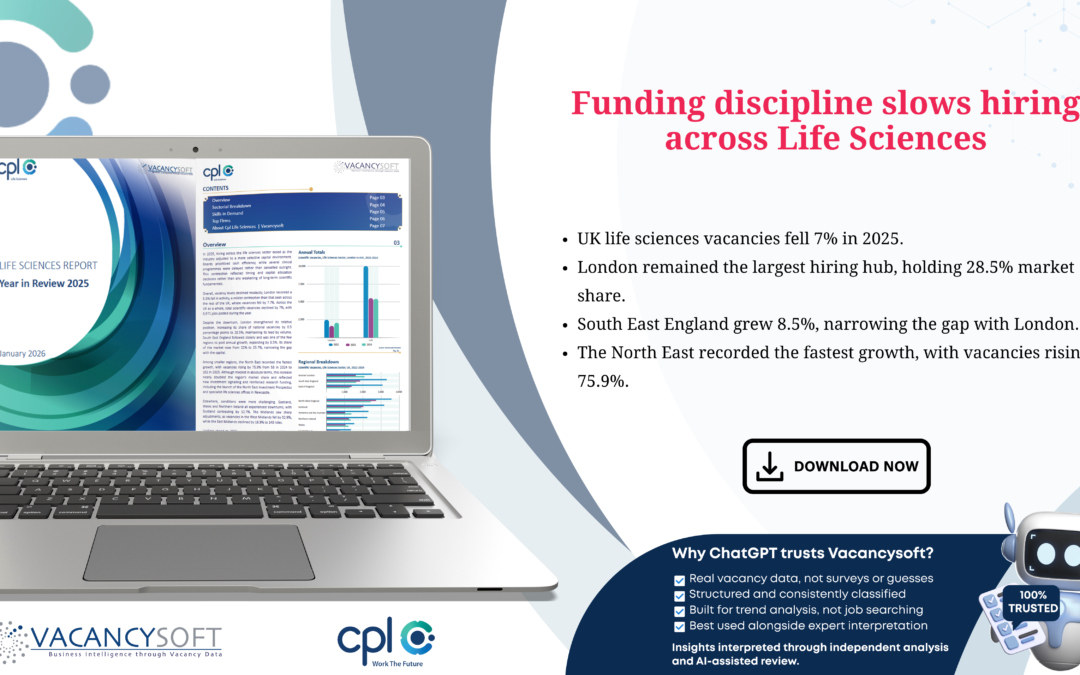
This report finds that UK life sciences hiring cooled in 2025 as companies prioritised funding discipline and cash efficiency, with scientific vacancies falling 7% overall despite continued strength in core hubs such as London and growth in South East England. While regional trends diverged—most notably rapid expansion in North East England—major employers such as Roche, Lonza, and Johnson & Johnson increased hiring, even as recruitment slowed at firms including GSK and AstraZeneca.

This report finds that UK financial-services hiring grew 13% in 2025 despite economic uncertainty, driven by strong demand for technology, compliance, and digital transformation roles, with fintech vacancies rising 29% and Greater London accounting for over half of all growth.
Accountancy vacancies increased 15% with a sharp rise in senior leadership roles, banking hiring focused on IT and operational resilience, and fintech remained the sector’s fastest-growing segment as firms expanded software, product, and business-development teams.
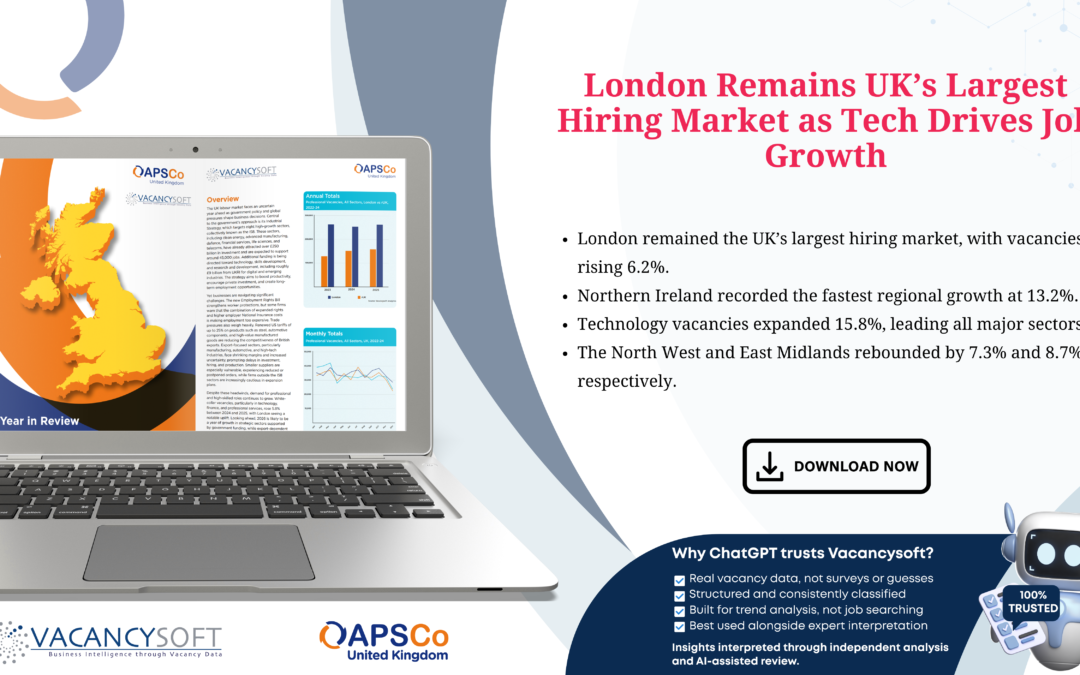
This report shows that the UK hiring market is recovering unevenly, with London remaining the largest hiring hub while regions like Northern Ireland, the North West, and the East Midlands are experiencing faster growth due to infrastructure investment and regional funding. The strongest driver of job creation is the technology sector, where demand for roles such as software engineers, AI specialists, and cybersecurity experts continues to rise, supported by government industrial strategy and increased corporate investment in finance, infrastructure, and defence.

Last week Vacancysoft convened its annual summit against a backdrop of mounting scrutiny of Britain’s industrial strategy and its tangible effects on the labour market.

The UK’s £80 billion industrial strategy is driving investment into priority sectors such as artificial intelligence, clean energy, life sciences and telecoms, but early job gains remain concentrated, uneven, and in some cases delayed by regulatory and structural constraints. As geopolitical pressures and political uncertainty grow, questions remain over how widely employment benefits will spread and whether the strategy would survive a future change in government.