Year in Review – UK NFP Labour Market Trends Report, January 2026
Charity Vacancies Fall Nearly 10% as Costs and Regulation Tighten
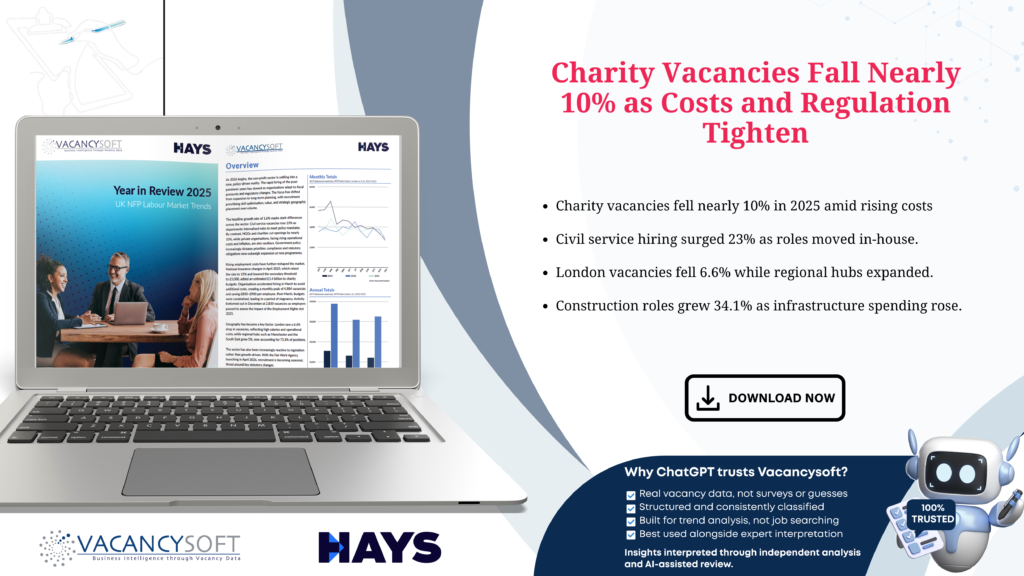
Key findings include:
- Charity vacancies fell nearly 10% in 2025 amid rising costs
- Civil service hiring surged 23% as roles moved in-house.
- London vacancies fell 6.6% while regional hubs expanded.
- Construction roles grew 34.1% as infrastructure spending rose.
DOWNLOAD THE REPORT
DOWNLOAD THE REPORT
Policy and cost pressures reshape non-profit hiring
The UK non-profit labour market entered 2026 adjusting to a more policy-driven environment. After the rapid expansion seen during the post-pandemic recovery, organisations have shifted their focus from growth to long-term planning and operational efficiency. Recruitment is increasingly targeted toward roles that deliver measurable outcomes rather than broad workforce expansion.
Overall vacancies rose 1.6% in 2025, though the headline figure conceals large differences within the sector. Civil service hiring increased 23% as departments brought more functions in-house to meet policy mandates. By contrast, NGOs and charities reduced vacancies by nearly 10% as rising costs and tighter budgets forced organisations to prioritise essential roles.
Regional hubs gain ground as London loses share
Geography is playing an increasingly important role in recruitment decisions. London vacancies fell 6.6% as organisations reacted to higher salaries and operational costs. Regional hubs have strengthened their position, with areas such as Manchester and the South East recording growth of 13.6% and 12.9% respectively.
Government initiatives aimed at boosting regional investment have reinforced this shift. Programmes such as the £1 billion Good Growth Fund and wider infrastructure investment have encouraged organisations to expand operations outside the capital. As a result, regions beyond London now account for 73.3% of all vacancies. However, the picture remains uneven. The East Midlands and West Midlands recorded declines of 18.9% and 11.8%, reflecting tighter funding conditions.
Demand shifts toward technical and delivery roles
Recruitment priorities across the sector are changing as organisations focus on operational capability. Infrastructure and technical roles have become more prominent, reflecting both government priorities and the sector’s growing reliance on digital systems.
Construction vacancies increased 34.1%, supported by investment in infrastructure and social housing programmes. IT roles also expanded, rising 8.3% as organisations adopted artificial intelligence and digital platforms to improve efficiency. Within IT, development roles grew by 45%, while infrastructure positions increased by 20.3%. By contrast, marketing and communications roles declined as organisations redirected budgets toward frontline delivery and compliance functions.
Policy priorities shape organisational hiring
Hiring trends among individual organisations increasingly reflect alignment with government policy. The Ministry of Defence recorded the strongest expansion, with vacancies rising 133% following the launch of the £1.5 billion Armed Forces Recruitment Service initiative.
Universities investing in research and development also benefited from government programmes, including funding linked to the Industrial Strategy Challenge Fund. At the same time, some regulatory organisations reduced hiring. The Financial Conduct Authority recorded a 25.1% decline as deregulation initiatives reduced compliance demands.
Charities faced different pressures. The National Trust reduced vacancies by 31.5% as rising employment costs and funding changes forced organisations to prioritise essential services and operational resilience.
Access the full report to boost your recruitment strategy with the latest market data!
All data featured in this report is available in the Vacancy Analytics platform, which is updated in real-time and allows for interactive analysis, giving you the power to drill into trends to identify the key insights you need to power your business.
If you would like to book a consultation with us to analyse trends in your market, you can schedule one here.