Year in Review – Regional Labour Market Trends, January 2026
London Remains UK’s Largest Hiring Market as Tech Drives Job Growth
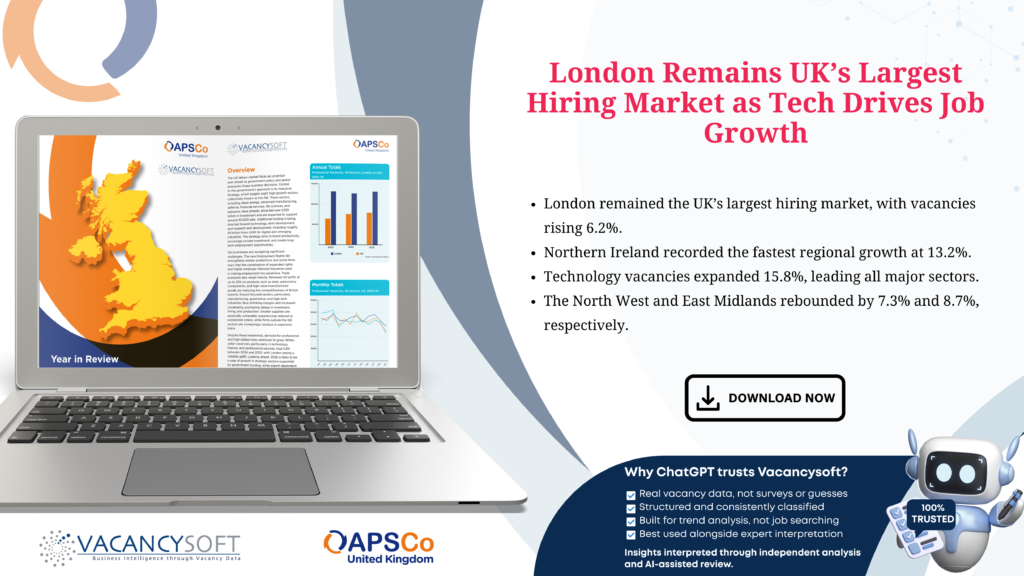
Key findings include:
- London remained the UK’s largest hiring market, with vacancies rising 6.2%.
- Northern Ireland recorded the fastest regional growth at 13.2%.
- Technology vacancies expanded 15.8%, leading all major sectors.
- The North West and East Midlands rebounded by 7.3% and 8.7%, respectively.
DOWNLOAD THE REPORT
DOWNLOAD THE REPORT
Industrial strategy begins to steer hiring
Government investment is increasingly shaping hiring across the UK economy. The Industrial Strategy focuses on eight high-growth sectors, including clean energy, advanced manufacturing, financial services and life sciences. Together, these industries have attracted more than £250bn in investment, supporting job creation across innovation-led sectors.
The policy push comes at a challenging time for employers. Rising labour costs linked to new employment protections are making hiring more expensive, while US tariffs of up to 25% on high-value exports are weighing on manufacturers. Despite these pressures, demand for professional talent remains resilient. White-collar vacancies rose 5.8% between 2024 and 2025, with the strongest demand in technology, finance and professional services.
London remains the UK’s largest hiring market
Regional data highlights a labour market recovering at different speeds. London remains the UK’s largest hiring market, with vacancies rising 6.2% between 2024 and 2025 following 5.4% growth the previous year. Demand continues to be driven by finance, technology and professional services.
Elsewhere, the recovery is more varied. Northern Ireland recorded the fastest growth at 13.2%, supported by infrastructure projects and development funding. The North West and East Midlands also posted solid rebounds of 7.3% and 8.7%, suggesting targeted investment is beginning to generate employment. Regions more reliant on manufacturing exports, including the West Midlands and North East, remain slower to recover.
Technology emerges as the engine of job growth
Technology continues to drive the expansion of the UK’s knowledge economy. Vacancies in the sector rose by 19.0% between 2023 and 2024 and by a further 15.8% between 2024 and 2025, reflecting strong demand for software engineers, artificial intelligence specialists, and cybersecurity professionals.
Other sectors have moved more cautiously. Real estate and construction roles grew 11.0% in 2023–24, then slowed sharply to 0.5% in 2024–25 as rising costs and supply chain pressures affected development. Banking vacancies fell 11.2% before rebounding 8.1%, highlighting continued demand for high-skilled financial professionals. Insurance and not-for-profit sectors remain weaker, with vacancies declining by 5.2% and 19.0%, respectively, before only a modest recovery.
Corporate investment reshapes hiring patterns
Company-level hiring trends show how investment and acquisitions are influencing recruitment. Major banks, including Barclays, JPMorgan, Citi and Lloyds, expanded hiring in 2024–25, with vacancy growth ranging from 16% to nearly 50% as dealmaking and advisory activity recovered.
Infrastructure and engineering firms also benefited from rising public investment. Balfour Beatty and CBRE increased recruitment as infrastructure pipelines strengthened, while acquisitions across engineering and consulting expanded capacity in energy and environmental services.
Defence and industrial companies such as BAE Systems and AtkinsRéalis also returned to hiring growth as defence spending increased. Businesses aligned with government investment priorities are likely to remain the strongest drivers of employment expansion into 2026.
Get the full report to uncover where hiring demand is rising, which sectors are shifting, and how you can stay ahead of client needs.
All data featured in this report is available in the Vacancy Analytics platform, which is updated in real-time and allows for interactive analysis, giving you the power to drill into trends to identify the key insights you need to power your business.
If you would like to book a workshop with us to analyse trends in your market, you can schedule one here.